01
Research organisation
Defining research questions, assumptions, methods, and technical priorities.
Development roadmap
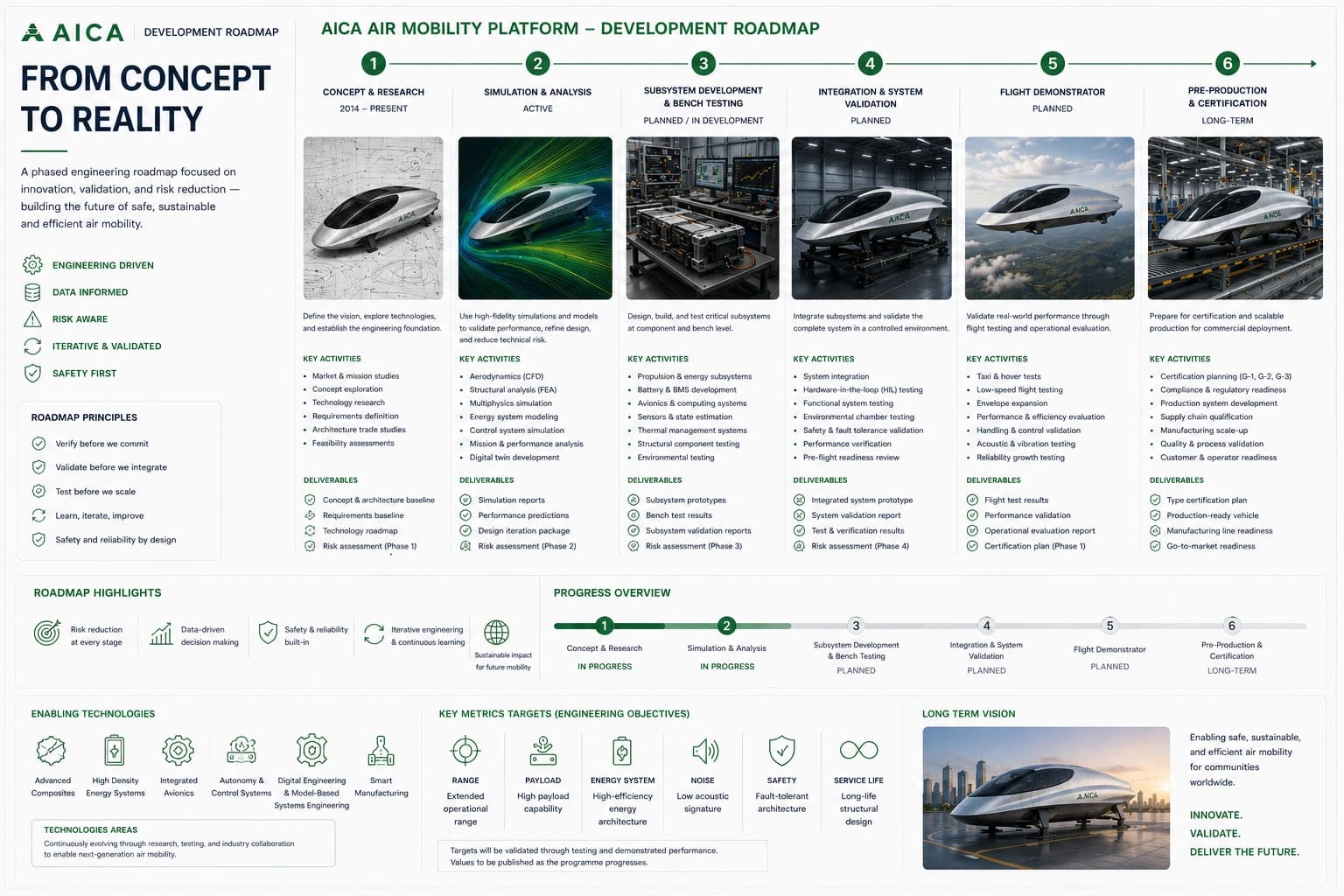
AICA follows a phased engineering programme designed to reduce uncertainty through analysis, simulation, subsystem development, integration, and future representative testing.
The roadmap describes programme direction rather than guaranteed delivery dates. Each phase depends on evidence, resources, technical outcomes, and the successful completion of earlier work.
Current programme stage
Research · Architecture · Validation Preparation
Current focus
01
Defining research questions, assumptions, methods, and technical priorities.
02
Developing the relationships between propulsion, energy, control, safety, structures, and software.
03
Preparing analytical, numerical, and digital models to compare candidate engineering approaches.
04
Defining subsystem tests, measurement needs, evidence standards, and future decision gates.
Development phases
Phase 01
2014 — Present
Develop the core concept, engineering assumptions, candidate architectures, and long-term research direction.
Representative work
Phase 02
Use analytical models and numerical simulation to evaluate engineering assumptions and compare alternative architectures.
Representative work
Phase 03
Future programme stage
Develop and physically evaluate individual subsystems before vehicle-level integration.
Representative work
Phase 04
Future programme stage
Integrate major subsystems and evaluate interfaces, control behaviour, safety logic, and system-level operation.
Representative work
Phase 05
Future programme stage
Create a representative demonstrator for controlled ground and later flight testing.
Representative work
Phase 06
Future programme stage
Translate validated engineering into repeatable manufacturing, formal compliance work, and production preparation.
Representative work
Evidence maturity
01
Supported by
02
Supported by
03
Supported by
04
Supported by
05
Supported by
Performance targets are not measured vehicle capabilities until supported by representative physical testing.
Decision gates
Gate A
Question
Is the architecture internally consistent and technically worth deeper investigation?
Gate B
Question
Do analytical and simulation results support continued development?
Gate C
Question
Do physical subsystem tests support integration?
Gate D
Question
Can the combined system proceed safely toward demonstrator testing?
Gate E
Question
Do measured results support further maturation, compliance work, and production planning?
Roadmap principles
01
Future dates depend on engineering outcomes, resources, and validation results.
02
Each phase should reduce a specific class of technical uncertainty.
03
Published capability statements should match the maturity of supporting evidence.
04
The roadmap may change when new engineering evidence changes programme priorities.
Research defines the questions, documentation records the reasoning, and the engineering journal preserves the programme history.